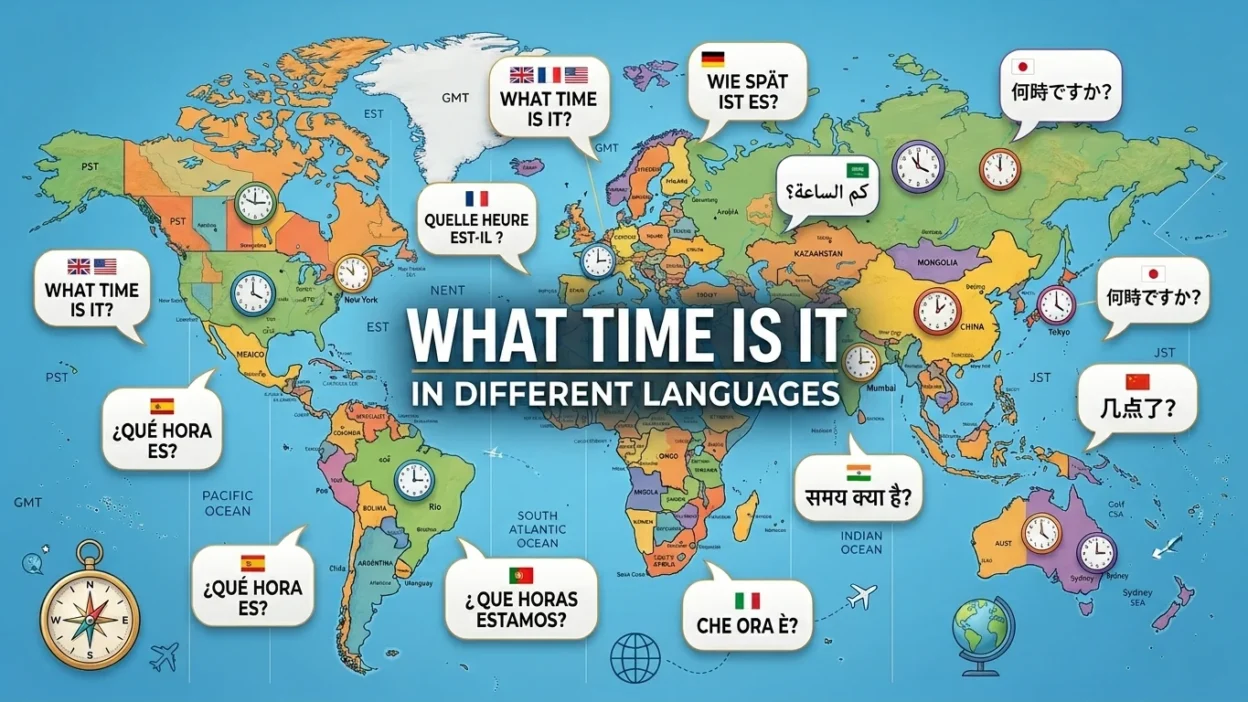
Many people start conversations with what’s your name or how are you, but what time is it is another common question used every day. It helps us know the time, manage timing, and stay on schedule. Whether you check a clock, use a phone, or ask someone nearby, this four-word question can be a useful conversation starter.
From my experience in language learning, mastering this simple question phrase improves speaking, boosts communication, and helps learners feel comfortable in any language. That is why what time is it in different languages is a practical topic for anyone interested in global communication.
When learning different languages, this simple English question often appears in real situations. You may hear it during a casual conversation, daily conversation, or friendly discussion. Sometimes everyone is wanting to catch the latest episode of a show, find out when an episode starts, or choose the perfect time to leave a party and run for it. Even when a clock is out of sight or a phone is out of reach, knowing the right words and phrase remains important.
This English expression is also a great ice breaker that encourages social interaction and helps people talk more naturally. While some may find it a little annoying, it is still useful in everyday communication. Whether you want to watch Game of Thrones, build confidence in a new language, strengthen human connection, or improve practical conversation skills, this phrase continues to be valuable.
What Time Is It in Different Languages Table
| Language | Native Phrase | Pronunciation | Example Sentence | English Meaning |
| English | What time is it? | wuht time iz it | What time is it now? | What is the current time? |
| Spanish | ¿Qué hora es? | kay OR-ah ess | ¿Qué hora es ahora? | What time is it now? |
| French | Quelle heure est-il ? | kel ur eh-teel | Quelle heure est-il maintenant ? | What time is it now? |
| German | Wie spät ist es? | vee shpate ist ess | Wie spät ist es jetzt? | What time is it now? |
| Italian | Che ora è? | kay OR-ah eh | Che ora è adesso? | What time is it now? |
| Portuguese | Que horas são? | kay OR-as sow | Que horas são agora? | What time is it now? |
| Dutch | Hoe laat is het? | hoo lat iss hut | Hoe laat is het nu? | What time is it now? |
| Russian | Который час? | ka-TO-riy chas | Который сейчас час? | What time is it now? |
| Ukrainian | Котра година? | KO-tra ho-DY-na | Котра година зараз? | What time is it now? |
| Polish | Która godzina? | kto-ra go-JEE-na | Która jest godzina? | What time is it? |
| Czech | Kolik je hodin? | KO-lik ye HO-din | Kolik je teď hodin? | What time is it now? |
| Slovak | Koľko je hodín? | KOL-ko ye ho-DEEN | Koľko je teraz hodín? | What time is it now? |
| Hungarian | Mennyi az idő? | MEN-nyi az EE-do | Mennyi az idő most? | What time is it now? |
| Romanian | Cât este ceasul? | kut ESS-te CHA-sul | Cât este ceasul acum? | What time is it now? |
| Greek | Τι ώρα είναι; | tee OR-a EE-ne | Τι ώρα είναι τώρα; | What time is it now? |
| Turkish | Saat kaç? | saat kach | Saat kaç şimdi? | What time is it now? |
| Arabic | كم الساعة؟ | kam as-sa-ah | كم الساعة الآن؟ | What time is it now? |
| Hebrew | מה השעה? | ma ha-sha-ah | מה השעה עכשיו? | What time is it now? |
| Persian | ساعت چند است؟ | sa-at chand ast | الان ساعت چند است؟ | What time is it now? |
| Urdu | وقت کیا ہوا ہے؟ | waqt kya hua hai | ابھی وقت کیا ہوا ہے؟ | What time is it now? |
| Hindi | क्या समय हुआ है? | kya samay hua hai | अभी क्या समय हुआ है? | What time is it now? |
| Bengali | কয়টা বাজে? | koy-ta ba-je | এখন কয়টা বাজে? | What time is it now? |
| Punjabi | ਕੀ ਵਕਤ ਹੋਇਆ ਹੈ? | kee waqt hoya hai | ਹੁਣ ਕੀ ਵਕਤ ਹੋਇਆ ਹੈ? | What time is it now? |
| Gujarati | કેટલા વાગ્યા? | ket-la vag-ya | અત્યારે કેટલા વાગ્યા? | What time is it now? |
| Marathi | किती वाजले? | ki-tee vaaj-lay | आता किती वाजले? | What time is it now? |
| Tamil | மணி என்ன? | ma-ni en-na | இப்போது மணி என்ன? | What time is it now? |
| Telugu | సమయం ఎంత? | sa-ma-yam en-tha | ఇప్పుడు సమయం ఎంత? | What time is it now? |
| Kannada | ಸಮಯ ಎಷ್ಟು? | sa-ma-ya esh-tu | ಈಗ ಸಮಯ ಎಷ್ಟು? | What time is it now? |
| Malayalam | സമയം എത്ര? | sa-ma-yam et-ra | ഇപ്പോൾ സമയം എത്ര? | What time is it now? |
| Sinhala | වෙලාව කීයද? | ve-la-va kee-ya-da | දැන් වෙලාව කීයද? | What time is it now? |
| Nepali | कति बज्यो? | ka-ti ba-jyo | अहिले कति बज्यो? | What time is it now? |
| Chinese | 现在几点? | shyen-zai jee-dyen | 现在几点了? | What time is it now? |
| Japanese | 今何時ですか? | ima nan-ji des-ka | 今何時ですか? | What time is it now? |
| Korean | 몇 시예요? | myot shi-ye-yo | 지금 몇 시예요? | What time is it now? |
| Thai | กี่โมงแล้ว | gee mong laew | ตอนนี้กี่โมงแล้ว | What time is it now? |
| Vietnamese | Mấy giờ rồi? | may yo roy | Bây giờ mấy giờ rồi? | What time is it now? |
| Indonesian | Jam berapa? | jam buh-ra-pa | Sekarang jam berapa? | What time is it now? |
| Malay | Pukul berapa? | poo-kul buh-ra-pa | Sekarang pukul berapa? | What time is it now? |
| Filipino | Anong oras na? | a-nong o-ras na | Anong oras na ngayon? | What time is it now? |
| Swahili | Saa ngapi? | sa nga-pee | Saa ngapi sasa? | What time is it now? |
| Afrikaans | Hoe laat is dit? | hoo laat is dit | Hoe laat is dit nou? | What time is it now? |
| Zulu | Isikhathi sini? | ee-si-kha-thee see-nee | Isikhathi sini manje? | What time is it now? |
| Xhosa | Lixesha lini? | lee-khe-sha lee-nee | Lixesha lini ngoku? | What time is it now? |
| Hausa | Wane lokaci ne? | wa-ne lo-ka-chee ne | Wane lokaci ne yanzu? | What time is it now? |
| Amharic | ስንት ሰዓት ነው? | sint seat new | አሁን ስንት ሰዓት ነው? | What time is it now? |
| Somali | Waa imisa saacadu? | waa ee-mee-sa saa-cha-du | Hadda waa imisa saacadu? | What time is it now? |
| Danish | Hvad er klokken? | veth air klo-ken | Hvad er klokken nu? | What time is it now? |
| Swedish | Vad är klockan? | vad air klok-an | Vad är klockan nu? | What time is it now? |
| Norwegian | Hva er klokka? | hva air klok-ka | Hva er klokka nå? | What time is it now? |
| Finnish | Paljonko kello on? | pal-yon-ko kel-lo on | Paljonko kello on nyt? | What time is it now? |
| Icelandic | Hvað er klukkan? | kva er kluk-kan | Hvað er klukkan núna? | What time is it now? |
| Irish | Cén t-am é? | kayn tom ay | Cén t-am é anois? | What time is it now? |
| Welsh | Faint o’r gloch yw hi? | vaynt oor gloch oo hee | Faint o’r gloch yw hi nawr? | What time is it now? |
| Scottish Gaelic | Dè an uair a tha e? | jay an oo-er a ha eh | Dè an uair a tha e a-nis? | What time is it now? |
| Croatian | Koliko je sati? | ko-lee-ko ye sa-tee | Koliko je sati sada? | What time is it now? |
| Serbian | Колико је сати? | ko-lee-ko ye sa-tee | Колико је сада сати? | What time is it now? |
| Bosnian | Koliko je sati? | ko-lee-ko ye sa-tee | Koliko je sada sati? | What time is it now? |
| Slovenian | Koliko je ura? | ko-lee-ko ye oo-ra | Koliko je ura zdaj? | What time is it now? |
| Lithuanian | Kiek valandų? | kyek va-lan-doo | Kiek dabar valandų? | What time is it now? |
| Latvian | Cik ir pulkstenis? | tsik ir pulk-ste-nis | Cik ir pulkstenis tagad? | What time is it now? |
| Estonian | Mis kell on? | mis kell on | Mis kell praegu on? | What time is it now? |
| Albanian | Sa është ora? | sa osh-tay o-ra | Sa është ora tani? | What time is it now? |
| Armenian | Ժամը քանիսն է | zha-muh ka-neesn e | Հիմա ժամը քանիսն է | What time is it now? |
| Georgian | რამდენი საათია? | ram-de-ni sa-a-ti-a | ახლა რამდენი საათია? | What time is it now? |
| Azerbaijani | Saat neçədir? | saat ne-che-dir | İndi saat neçədir? | What time is it now? |
| Kazakh | Сағат неше? | sa-ghat ne-she | Қазір сағат неше? | What time is it now? |
| Uzbek | Soat nechchi? | so-at nech-chee | Hozir soat nechchi? | What time is it now? |
| Mongolian | Цаг хэд болж байна? | tsag hed bolj baina | Одоо цаг хэд болж байна? | What time is it now? |
| Khmer | ម៉ោងប៉ុន្មាន? | maong pon-man | ឥឡូវម៉ោងប៉ុន្មាន? | What time is it now? |
| Lao | ເວລາເທົ່າໃດ? | vay-la thao-dai | ຕອນນີ້ເວລາເທົ່າໃດ? | What time is it now? |
| Burmese | ဘယ်နှနာရီလဲ | beh na-yee le | အခုဘယ်နှနာရီလဲ | What time is it now? |
| Esperanto | Kioma horo estas? | kee-o-ma ho-ro es-tas | Kioma horo estas nun? | What time is it now? |
| Latin | Qua hora est? | kwa ho-ra est | Qua hora est nunc? | What time is it now? |
How to Say What Time Is It in Different Languages
The phrase “What time is it?” is one of the most useful travel and communication expressions. Whether you are visiting another country, studying languages, or talking to international friends, knowing these translations helps you communicate naturally.
Many languages use words related to clocks, hours, or current time. Others ask directly about the hour or moment. Learning these differences helps improve vocabulary and cultural understanding.
What Time Is It in All Languages for Travelers
Travelers frequently need to ask for the time in airports, train stations, hotels, restaurants, and public transportation areas. Memorizing a few common phrases can make communication easier and reduce misunderstandings.
The most widely used versions include Spanish, French, German, Arabic, Chinese, Japanese, and Hindi because these languages are spoken by millions of people around the world.
What Time Is It Translations Around the World
Languages reflect different cultures and ways of speaking. Some languages ask “What hour is it?” while others ask “How many hours?” or “Which hour is it?”
These small differences make language learning more interesting and help learners understand how people express time around the world.
Why Learn Time Expressions in Different Languages?
Learning time-related phrases offers several benefits:
- Helps during travel.
- Improves language skills.
- Makes conversations easier.
- Builds cultural awareness.
- Increases confidence when speaking with native speakers.
Knowing how to ask the time is one of the first practical expressions language learners usually study.
Conclusion
Understanding what time is it in different languages allows you to communicate more effectively wherever you travel. These 70 translations demonstrate how people around the world ask about time in their native languages. Learning even a few of these phrases can improve conversations, travel experiences, and language skills.
FAQs:
1. How do you say what time is it in different languages?
The phrase changes depending on the language. Spanish uses “¿Qué hora es?” while French uses “Quelle heure est-il?”
2. Why should I learn what time is it in all languages?
Learning these phrases helps with travel, language study, and communication with people from different countries.
3. Which languages use similar phrases for asking time?
Many European languages use phrases that translate to “What hour is it?” while others ask “How many hours?”
4. Is asking the time important for travelers?
Yes. It helps when using transportation, attending meetings, and managing schedules abroad.
5. What is the easiest way to memorize time translations?
Practice common phrases daily, listen to native pronunciations, and use them in real conversations.