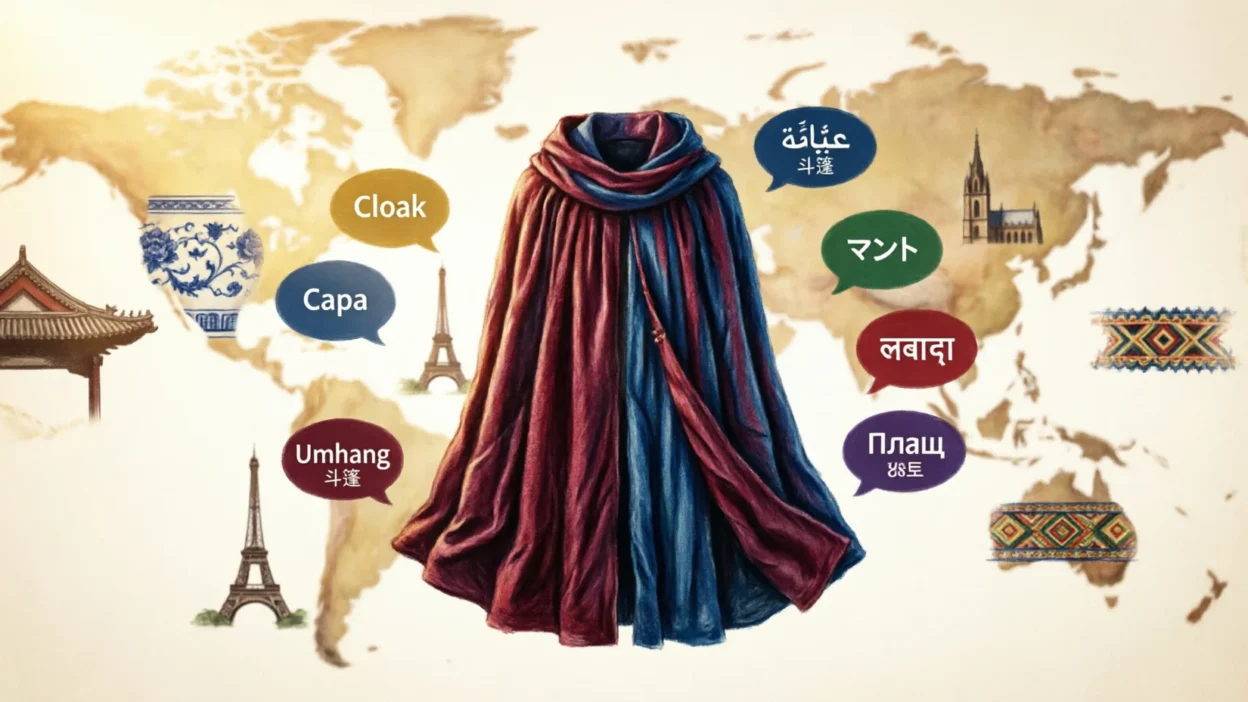
Exploring cloak in different languages is an effective way to understand this word through accurate translation, translations, and examples from other languages. A reliable reference page often features examples from over 100 languages, helping learners compare usage across different cultures and regions.
In my experience with multilingual resources, combining audio pronunciation and written examples makes it easier to learn, read, and pronounce new words correctly. Many language databases provide recordings in more than 40 languages, allowing users to listen, improve pronunciation, and build practical vocabulary.
For anyone interested in language learning, studying languages around the world connects meaning, sound, and usage, while hearing native speakers strengthens overall communication skills and confidence.
Cloak in Different Languages Table
| Language | Translation | Pronunciation | Example Sentence | English Meaning |
|---|---|---|---|---|
| English | Cloak | klohk | I wear a cloak in winter. | I wear a cloak in winter. |
| Spanish | Capa | KAH-pah | Llevo una capa negra. | I wear a black cloak. |
| French | Cape | kahp | Je porte une cape. | I wear a cloak. |
| German | Umhang | OOM-hang | Ich trage einen Umhang. | I wear a cloak. |
| Italian | Mantello | man-TEL-lo | Indosso un mantello. | I wear a cloak. |
| Portuguese | Capa | KAH-pah | Uso uma capa. | I use a cloak. |
| Dutch | Mantel | MAN-tel | Ik draag een mantel. | I wear a cloak. |
| Swedish | Kappa | KAP-pa | Jag bär en kappa. | I wear a cloak. |
| Norwegian | Kappe | KAP-peh | Jeg bruker en kappe. | I use a cloak. |
| Danish | Kappe | KAP-peh | Jeg har en kappe på. | I am wearing a cloak. |
| Finnish | Viitta | VEE-ta | Minulla on viitta. | I have a cloak. |
| Icelandic | Skikkja | SKIK-ya | Ég klæðist skikkju. | I wear a cloak. |
| Irish | Clóca | KLO-ka | Tá clóca orm. | I am wearing a cloak. |
| Welsh | Mantell | MAN-thel | Rwy’n gwisgo mantell. | I wear a cloak. |
| Scottish Gaelic | Cleòc | KLYOHK | Tha cleòc orm. | I am wearing a cloak. |
| Polish | Peleryna | pe-le-RI-na | Mam pelerynę. | I have a cloak. |
| Czech | Plášť | PLASHT | Mám plášť. | I have a cloak. |
| Slovak | Plášť | PLASHT | Nosím plášť. | I wear a cloak. |
| Slovenian | Plašč | PLASHCH | Nosim plašč. | I wear a cloak. |
| Croatian | Plašt | PLASHT | Nosim plašt. | I wear a cloak. |
| Serbian | Плашт | PLASHT | Nosim plašt. | I wear a cloak. |
| Bosnian | Plašt | PLASHT | Nosim plašt. | I wear a cloak. |
| Macedonian | Наметка | NA-met-ka | Носам наметка. | I wear a cloak. |
| Bulgarian | Пелерина | pe-le-ri-NA | Нося пелерина. | I wear a cloak. |
| Romanian | Pelerină | pe-le-RI-na | Port o pelerină. | I wear a cloak. |
| Hungarian | Köpeny | KER-pehn | Köpenyt viselek. | I wear a cloak. |
| Albanian | Pelerinë | pe-le-RI-ne | Vesh një pelerinë. | I wear a cloak. |
| Greek | Κάπα | KA-pa | Φοράω κάπα. | I wear a cloak. |
| Russian | Плащ | PLASHCH | Я ношу плащ. | I wear a cloak. |
| Ukrainian | Плащ | PLASHCH | Я ношу плащ. | I wear a cloak. |
| Belarusian | Плашч | PLASHCH | Я нашу плашч. | I wear a cloak. |
| Lithuanian | Apsiaustas | ap-sy-AUS-tas | Dėviu apsiaustą. | I wear a cloak. |
| Latvian | Apmetnis | AP-met-nis | Es valkāju apmetni. | I wear a cloak. |
| Estonian | Keep | KAYP | Ma kannan keepi. | I wear a cloak. |
| Turkish | Pelerin | pe-le-RIN | Pelerin giyiyorum. | I am wearing a cloak. |
| Azerbaijani | Pelerin | pe-le-RIN | Pelerin geyinirəm. | I wear a cloak. |
| Kazakh | Шапан | sha-PAN | Мен шапан киемін. | I wear a cloak. |
| Uzbek | Plashch | PLASHCH | Men plashch kiyaman. | I wear a cloak. |
| Kyrgyz | Плащ | PLASHCH | Мен плащ кийем. | I wear a cloak. |
| Tajik | Плаш | PLASH | Ман плаш мепӯшам. | I wear a cloak. |
| Armenian | Թիկնոց | tik-NOTS | Ես թիկնոց եմ հագնում։ | I wear a cloak. |
| Georgian | მოსასხამი | mo-sa-sKHA-mi | მე მოსასხამი მაცვია. | I am wearing a cloak. |
| Arabic | عباءة | a-BA-ya | أرتدي عباءة. | I wear a cloak. |
| Hebrew | גלימה | gli-MA | אני לובש גלימה. | I wear a cloak. |
| Persian | شنل | she-NEL | من شنل میپوشم. | I wear a cloak. |
| Urdu | چغہ | CHO-gha | میں چغہ پہنتا ہوں۔ | I wear a cloak. |
| Hindi | लबादा | la-BA-da | मैं लबादा पहनता हूँ। | I wear a cloak. |
| Bengali | আলখাল্লা | al-khal-LA | আমি আলখাল্লা পরি। | I wear a cloak. |
| Punjabi | ਚੋਗਾ | CHO-ga | ਮੈਂ ਚੋਗਾ ਪਾਉਂਦਾ ਹਾਂ। | I wear a cloak. |
| Gujarati | ચોગો | CHO-go | હું ચોગો પહેરું છું. | I wear a cloak. |
| Marathi | झगा | ZHA-ga | मी झगा घालतो. | I wear a cloak. |
| Nepali | लबादा | la-BA-da | म लबादा लगाउँछु। | I wear a cloak. |
| Sinhala | සළුව | sa-LU-wa | මම සළුවක් අඳිමි. | I wear a cloak. |
| Tamil | மேலங்கி | me-LAN-gi | நான் மேலங்கி அணிகிறேன். | I wear a cloak. |
| Telugu | అంగి | AN-gi | నేను అంగి ధరిస్తాను. | I wear a cloak. |
| Kannada | ಮೇಲಂಗಿ | may-LAN-gi | ನಾನು ಮೇಲಂಗಿ ಧರಿಸುತ್ತೇನೆ. | I wear a cloak. |
| Malayalam | മേലങ്കി | may-LAN-ki | ഞാൻ മേലങ്കി ധരിക്കുന്നു. | I wear a cloak. |
| Chinese (Mandarin) | 斗篷 | doh-pung | 我穿着斗篷。 | I am wearing a cloak. |
| Japanese | マント | MAN-to | マントを着ています。 | I am wearing a cloak. |
| Korean | 망토 | MANG-to | 망토를 입고 있어요. | I am wearing a cloak. |
| Vietnamese | Áo choàng | ow CHWANG | Tôi mặc áo choàng. | I wear a cloak. |
| Thai | เสื้อคลุม | suea-kloom | ฉันสวมเสื้อคลุม | I wear a cloak. |
| Indonesian | Jubah | JOO-bah | Saya memakai jubah. | I wear a cloak. |
| Malay | Jubah | JOO-bah | Saya memakai jubah. | I wear a cloak. |
| Filipino | Balabal | ba-LA-bal | Suot ko ang balabal. | I am wearing a cloak. |
| Swahili | Joho | JO-ho | Ninavaa joho. | I wear a cloak. |
| Zulu | Ingubo | in-GOO-bo | Ngigqoke ingubo. | I am wearing a cloak. |
| Afrikaans | Mantel | MAN-tel | Ek dra ‘n mantel. | I wear a cloak. |
| Yoruba | Aṣọ àborí | a-sho a-bo-ri | Mo wọ aṣọ àborí. | I wear a cloak. |
| Hausa | Alkyabba | al-KYAB-ba | Ina sa alkyabba. | I wear a cloak. |
| Amharic | ካባ | KA-ba | ካባ ለብሻለሁ። | I wear a cloak. |
| Mongolian | Нөмрөг | NOM-rog | Би нөмрөг өмсдөг. | I wear a cloak. |
How to Say Cloak in Different Languages
The word for cloak varies greatly across cultures and language families. European languages often use terms related to capes and mantles, while Asian and Middle Eastern languages frequently use words connected to traditional outer garments. Despite the differences, the concept remains similar: a loose garment worn over clothing for protection, warmth, or style.
Cloak Translations Around the World
Many cloak translations have historical roots. In medieval Europe, cloaks were common everyday garments. In other regions, similar clothing items evolved into ceremonial robes, capes, shawls, or traditional outerwear. This is why some translations may also refer to robes or mantle-like garments depending on cultural context.
Why Learn Cloak in All Languages?
Learning vocabulary across multiple languages can help you:
- Improve language-learning skills
- Understand cultural clothing traditions
- Communicate while traveling
- Enhance translation projects
- Expand multilingual vocabulary knowledge
If you are studying languages, knowing how to say cloak in different languages can also help you recognize related words in literature, history, and fantasy fiction.
Conclusion
Understanding cloak in different languages offers a fascinating glimpse into global vocabulary and cultural traditions. From European capes to Asian and Middle Eastern outer garments, these translations show how a simple piece of clothing is expressed around the world. Use this guide whenever you need quick and accurate cloak translations across multiple languages.
FAQs:
1. How do you say cloak in different languages?
The word cloak has unique translations in different languages, such as capa in Spanish, cape in French, Umhang in German, and 斗篷 in Chinese.
2. What is the most common translation of cloak?
Many languages use words that translate directly to cloak, cape, mantle, or outer covering, depending on local usage.
3. Why are cloak translations different around the world?
Languages developed independently and often adapted words based on local clothing traditions and historical influences.
4. Is a cloak the same as a cape in every language?
Not always. Some languages distinguish between a cloak and a cape, while others use one word for both garments.
5. Where can cloak translations be useful?
They are useful for language learning, travel, literature, history studies, translation work, and cultural research.

Roman Miles is an author at Lingoboxes, a language learning platform. He writes clear and engaging articles that help readers understand different languages, grammar rules, vocabulary, and cultural expressions effectively.