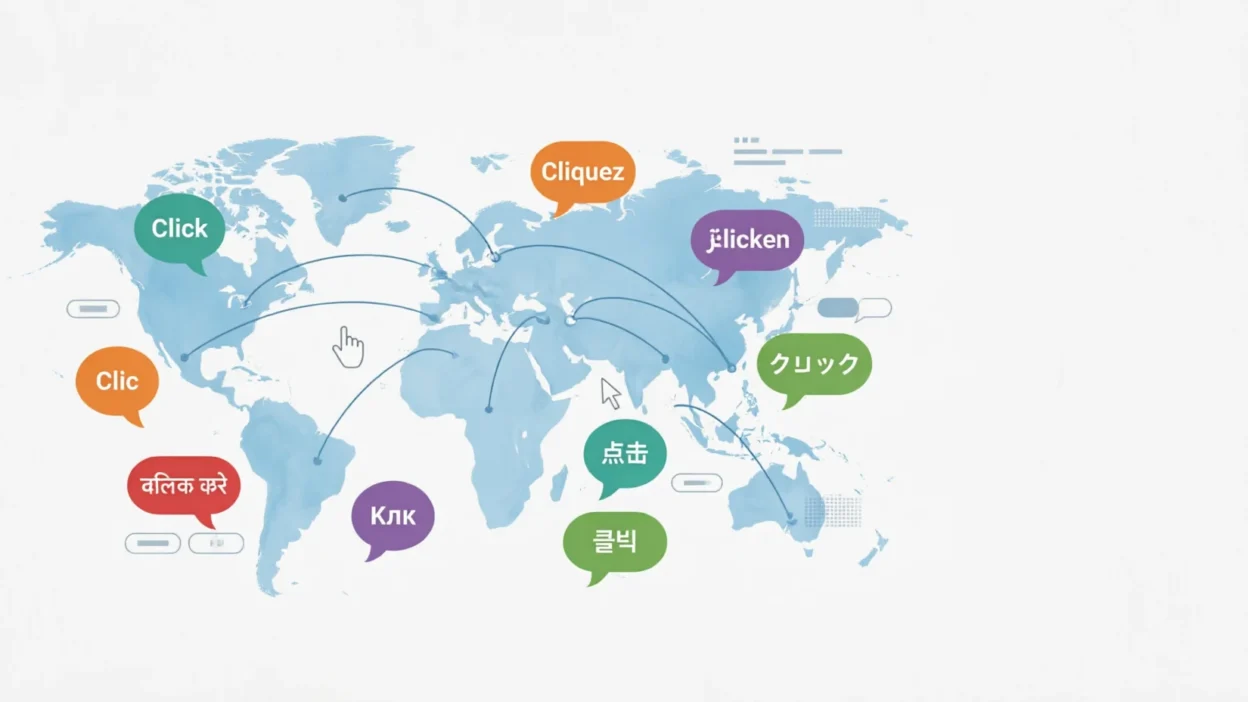
If you want to learn click in different languages, this page is a practical place to start. It presents many ways to say the word through accurate translation and translations across major languages in a truly multilingual format. With over 100 language entries and more than 40 audio recordings, you can listen to native speakers, improve your pronunciation, pronounce each phrase naturally, and read every example with confidence.
While building your vocabulary, you will also discover interesting linguistic differences that connect people on a global and worldwide scale. From my own experience, combining listening with reading makes language learning faster, easier, and far more memorable for beginners and experienced learners alike.
Click in Different Languages
| Language | Native Phrase | Pronunciation | Example Sentence | English Meaning |
|---|---|---|---|---|
| English | Click | Klik | Click the button. | Press the button. |
| Spanish | Haz clic | Ahz Kleek | Haz clic aquí. | Click here. |
| French | Cliquez | Klee-kay | Cliquez ici. | Click here. |
| German | Klicken | KLIK-en | Klicken Sie hier. | Click here. |
| Italian | Fai clic | Fai Kleek | Fai clic sul link. | Click the link. |
| Portuguese | Clique | KLEE-kee | Clique aqui. | Click here. |
| Dutch | Klik | Klik | Klik hier. | Click here. |
| Swedish | Klicka | KLIK-ah | Klicka här. | Click here. |
| Norwegian | Klikk | Klik | Klikk her. | Click here. |
| Danish | Klik | Klik | Klik her. | Click here. |
| Finnish | Napsauta | NAP-sow-ta | Napsauta tästä. | Click here. |
| Icelandic | Smelltu | SMETL-tu | Smelltu hér. | Click here. |
| Polish | Kliknij | KLEEK-neey | Kliknij tutaj. | Click here. |
| Czech | Klikněte | KLIK-nye-te | Klikněte zde. | Click here. |
| Slovak | Kliknite | KLIK-nee-te | Kliknite sem. | Click here. |
| Slovenian | Kliknite | KLIK-nee-te | Kliknite tukaj. | Click here. |
| Croatian | Kliknite | KLIK-nee-te | Kliknite ovdje. | Click here. |
| Serbian | Кликните | KLIK-nee-te | Кликните овде. | Click here. |
| Bosnian | Kliknite | KLIK-nee-te | Kliknite ovdje. | Click here. |
| Romanian | Faceți clic | FA-chets Kleek | Faceți clic aici. | Click here. |
| Hungarian | Kattintson | Kat-TIN-chon | Kattintson ide. | Click here. |
| Greek | Κάντε κλικ | KAN-de Klik | Κάντε κλικ εδώ. | Click here. |
| Bulgarian | Щракнете | SHRAK-ne-te | Щракнете тук. | Click here. |
| Russian | Нажмите | Nahzh-MEE-te | Нажмите здесь. | Click here. |
| Ukrainian | Натисніть | Na-TIS-neet | Натисніть тут. | Click here. |
| Belarusian | Націсніце | Na-TSEES-nee-tse | Націсніце тут. | Click here. |
| Lithuanian | Spustelėkite | Spoos-teh-LAY-kee-te | Spustelėkite čia. | Click here. |
| Latvian | Noklikšķiniet | No-KLIK-shi-nyet | Noklikšķiniet šeit. | Click here. |
| Estonian | Klõpsake | KLOP-sa-ke | Klõpsake siin. | Click here. |
| Turkish | Tıklayın | Tuk-luh-YUN | Buraya tıklayın. | Click here. |
| Arabic | انقر | Un-qur | انقر هنا. | Click here. |
| Hebrew | לחץ | Lah-HATZ | לחץ כאן. | Click here. |
| Persian | کلیک کنید | KleeK Ko-need | اینجا کلیک کنید. | Click here. |
| Urdu | کلک کریں | Click Karein | یہاں کلک کریں۔ | Click here. |
| Hindi | क्लिक करें | Klik Karen | यहाँ क्लिक करें। | Click here. |
| Bengali | ক্লিক করুন | Klik Korun | এখানে ক্লিক করুন। | Click here. |
| Punjabi | ਕਲਿੱਕ ਕਰੋ | Klik Karo | ਇੱਥੇ ਕਲਿੱਕ ਕਰੋ। | Click here. |
| Gujarati | ક્લિક કરો | Klik Karo | અહીં ક્લિક કરો. | Click here. |
| Marathi | क्लिक करा | Klik Kara | येथे क्लिक करा. | Click here. |
| Tamil | கிளிக் செய்யவும் | Klik Seyyavum | இங்கே கிளிக் செய்யவும். | Click here. |
| Telugu | క్లిక్ చేయండి | Klik Cheyandi | ఇక్కడ క్లిక్ చేయండి. | Click here. |
| Kannada | ಕ್ಲಿಕ್ ಮಾಡಿ | Klik Maadi | ಇಲ್ಲಿ ಕ್ಲಿಕ್ ಮಾಡಿ. | Click here. |
| Malayalam | ക്ലിക്ക് ചെയ്യുക | Klik Cheyyuka | ഇവിടെ ക്ലിക്ക് ചെയ്യുക. | Click here. |
| Sinhala | ක්ලික් කරන්න | Klik Karanna | මෙතන ක්ලික් කරන්න. | Click here. |
| Nepali | क्लिक गर्नुहोस् | Klik Garnuhos | यहाँ क्लिक गर्नुहोस्। | Click here. |
| Chinese (Simplified) | 点击 | Dee-an Jee | 点击这里。 | Click here. |
| Chinese (Traditional) | 點擊 | Dee-an Jee | 點擊這裡。 | Click here. |
| Japanese | クリックしてください | Ku-ri-ku Shi-te Ku-da-sai | ここをクリックしてください。 | Please click here. |
| Korean | 클릭하세요 | Keul-lik Ha-se-yo | 여기를 클릭하세요. | Please click here. |
| Vietnamese | Nhấp vào | Nyup Vao | Nhấp vào đây. | Click here. |
| Thai | คลิก | Khlik | คลิกที่นี่ | Click here. |
| Indonesian | Klik | Klik | Klik di sini. | Click here. |
| Malay | Klik | Klik | Klik di sini. | Click here. |
| Filipino | I-click | Ee-Klik | I-click ito. | Click this. |
| Swahili | Bofya | BOF-ya | Bofya hapa. | Click here. |
| Zulu | Chofoza | Cho-FO-za | Chofoza lapha. | Click here. |
| Afrikaans | Klik | Klik | Klik hier. | Click here. |
| Somali | Guji | Goo-jee | Guji halkan. | Click here. |
| Amharic | ጠቅ ያድርጉ | Tak Yadregu | እዚህ ጠቅ ያድርጉ። | Click here. |
| Hausa | Danna | DAN-na | Danna nan. | Click here. |
| Yoruba | Tẹ | Teh | Tẹ ibi. | Click here. |
| Igbo | Pịa | Pee-ah | Pịa ebe a. | Click here. |
| Irish | Cliceáil | Kli-KALE | Cliceáil anseo. | Click here. |
| Welsh | Cliciwch | KLIK-ee-ookh | Cliciwch yma. | Click here. |
| Scottish Gaelic | Briog | Bree-og | Briog an seo. | Click here. |
| Basque | Egin klik | EH-gin Klik | Egin klik hemen. | Click here. |
| Catalan | Fes clic | Fes Kleek | Fes clic aquí. | Click here. |
| Galician | Fai clic | Fai Kleek | Fai clic aquí. | Click here. |
| Maltese | Ikklikkja | Ik-KLIK-ya | Ikklikkja hawn. | Click here. |
| Albanian | Klikoni | Klee-KO-nee | Klikoni këtu. | Click here. |
| Macedonian | Кликнете | KLIK-ne-te | Кликнете тука. | Click here. |
| Georgian | დააჭირეთ | Da-a-CHEE-ret | აქ დააჭირეთ. | Click here. |
| Armenian | Սեղմեք | Segh-MEK | Սեղմեք այստեղ։ | Click here. |
| Mongolian | Дарна уу | Dar-na Uu | Энд дарна уу. | Click here. |
Why Learn Click in Different Languages?
Learning click in different languages is useful for travelers, translators, software developers, website owners, customer support teams, and language learners. Since the word is commonly used in websites, mobile applications, online forms, and digital instructions, understanding its translation helps users navigate technology more confidently.
Many languages use a direct translation, while others borrow the English word “click” because of its widespread use in technology. Knowing these differences improves multilingual communication and localization.
How to Say Click in Different Languages
If you need to communicate with international audiences, learning how to say click in different languages makes software instructions, tutorials, websites, and digital products easier to understand. Most translations are commonly used in computer interfaces, mobile apps, and online guides.
Click Translations Around the World
The word “click” has become part of everyday digital life. Although many languages have their own native equivalent, several languages simply adapt the English pronunciation. These click translations reflect how technology has influenced modern vocabulary across cultures and countries.
Common Uses of the Word Click
The word “click” is frequently used in:
- Websites and online forms
- Mobile applications
- Computer software
- Digital advertisements
- User manuals
- Online tutorials
- E-commerce stores
- Educational platforms
Understanding click around the world can improve user experience and make multilingual content more accessible.
Conclusion
Learning click in different languages is valuable for language learners, travelers, developers, translators, and anyone working with international audiences. The translations above show how this everyday digital term is used across 70 languages, making communication easier in today’s connected world.
FAQs:
1. How do you say click in different languages?
Different languages use either native words or adapted English forms. The table above provides 70 accurate translations with pronunciation and examples.
2. Is the word “click” the same in every language?
No. Some languages use their own verb for clicking, while others borrow the English word because of technology.
3. Why is click commonly borrowed from English?
English has greatly influenced technology, software, and the internet, so many languages adopted “click” directly or with slight pronunciation changes.
4. Where are click translations commonly used?
They are mainly used in websites, mobile apps, software interfaces, online tutorials, digital documents, and user guides.
5. Why should I learn click in all languages?
Knowing click in all languages helps with travel, translation, language learning, website localization, and communicating with international users more effectively.