
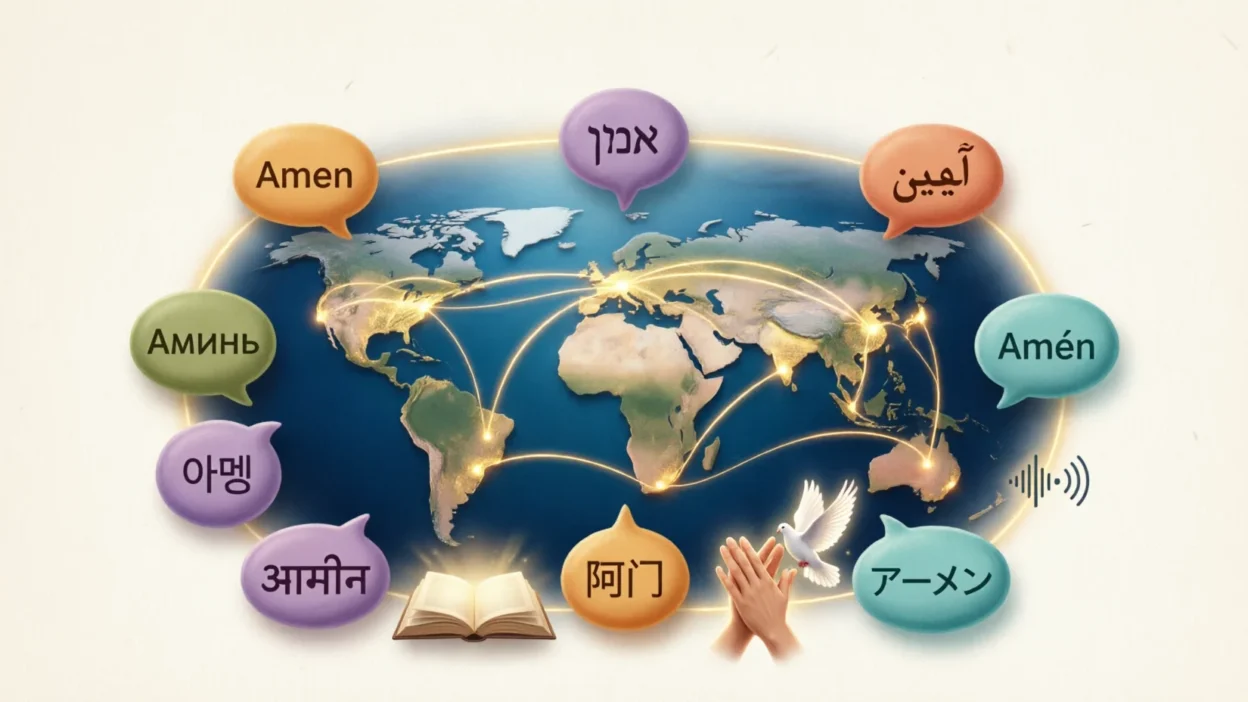
If you are interested in amen in different languages, there are many ways to explore this meaningful word across cultures. A page that features the translation of amen in over 100 languages can help readers discover how people say amen around the world.
These examples from other languages show how one expression connects communities through faith, culture, and communication. Many learners also enjoy listening to audio pronunciation recordings in more than 40 languages to learn how to pronounce amen correctly. Native speakers often make pronunciation easier to understand than written guides alone.
For language learning, it is useful to read amen in different writing systems and compare language translations. Studying amen translations from different regions reveals how languages preserve meaning while supporting multilingual communication and strengthening connections across global languages.
Amen in Different Languages Table
| Language | Native Phrase | Pronunciation | Example Sentence | English Meaning |
|---|---|---|---|---|
| English | Amen | Ah-men | We ended the prayer with Amen. | We ended the prayer with Amen. |
| Spanish | Amén | Ah-men | Terminamos la oración con Amén. | We finished the prayer with Amen. |
| French | Amen | Ah-mahn | Nous avons dit Amen à la fin. | We said Amen at the end. |
| German | Amen | Ah-men | Wir sagten Amen nach dem Gebet. | We said Amen after the prayer. |
| Italian | Amen | Ah-men | Abbiamo detto Amen insieme. | We said Amen together. |
| Portuguese | Amém | Ah-meng | Todos responderam Amém. | Everyone answered Amen. |
| Dutch | Amen | Ah-men | Ze zeiden Amen na het gebed. | They said Amen after the prayer. |
| Swedish | Amen | Ah-men | Vi avslutade med Amen. | We ended with Amen. |
| Norwegian | Amen | Ah-men | Menigheten sa Amen. | The congregation said Amen. |
| Danish | Amen | Ah-men | Alle sagde Amen. | Everyone said Amen. |
| Finnish | Aamen | Aa-men | He sanoivat Aamen. | They said Amen. |
| Icelandic | Amen | Ah-men | Fólkið sagði Amen. | The people said Amen. |
| Irish | Amen | Ah-men | Dúirt siad Amen. | They said Amen. |
| Welsh | Amen | Ah-men | Dywedwyd Amen ar y diwedd. | Amen was said at the end. |
| Scottish Gaelic | Amen | Ah-men | Thuirt iad Amen. | They said Amen. |
| Polish | Amen | Ah-men | Powiedzieli Amen. | They said Amen. |
| Czech | Amen | Ah-men | Řekli Amen po modlitbě. | They said Amen after the prayer. |
| Slovak | Amen | Ah-men | Povedali Amen. | They said Amen. |
| Slovenian | Amen | Ah-men | Rekli so Amen. | They said Amen. |
| Croatian | Amen | Ah-men | Rekli su Amen. | They said Amen. |
| Serbian | Амин | Ah-meen | Рекли су Амин. | They said Amen. |
| Bosnian | Amin | Ah-meen | Svi su rekli Amin. | Everyone said Amen. |
| Macedonian | Амин | Ah-meen | Сите рекоа Амин. | Everyone said Amen. |
| Bulgarian | Амин | Ah-meen | Те казаха Амин. | They said Amen. |
| Romanian | Amin | Ah-meen | Toți au spus Amin. | Everyone said Amen. |
| Hungarian | Ámen | Aa-men | Áment mondtak. | They said Amen. |
| Albanian | Amin | Ah-meen | Ata thanë Amin. | They said Amen. |
| Greek | Αμήν | Ah-meen | Είπαν Αμήν. | They said Amen. |
| Russian | Аминь | Ah-meen | Они сказали Аминь. | They said Amen. |
| Ukrainian | Амінь | Ah-meen | Вони сказали Амінь. | They said Amen. |
| Belarusian | Амін | Ah-meen | Яны сказалі Амін. | They said Amen. |
| Lithuanian | Amen | Ah-men | Jie pasakė Amen. | They said Amen. |
| Latvian | Āmen | Aa-men | Viņi teica Āmen. | They said Amen. |
| Estonian | Aamen | Aa-men | Nad ütlesid Aamen. | They said Amen. |
| Turkish | Amin | Ah-meen | Herkes Amin dedi. | Everyone said Amen. |
| Arabic | آمين | Aa-meen | قال الجميع آمين. | Everyone said Amen. |
| Hebrew | אמן | Ah-men | כולם אמרו אמן. | Everyone said Amen. |
| Persian | آمین | Aa-meen | همه آمین گفتند. | Everyone said Amen. |
| Urdu | آمین | Aa-meen | سب نے آمین کہا۔ | Everyone said Amen. |
| Hindi | आमीन | Aa-meen | सभी ने आमीन कहा। | Everyone said Amen. |
| Bengali | আমিন | Aa-meen | সবাই আমিন বলল। | Everyone said Amen. |
| Punjabi | ਆਮੀਨ | Aa-meen | ਸਭ ਨੇ ਆਮੀਨ ਕਿਹਾ। | Everyone said Amen. |
| Gujarati | આમીન | Aa-meen | બધાએ આમીન કહ્યું. | Everyone said Amen. |
| Marathi | आमीन | Aa-meen | सर्वांनी आमीन म्हटले. | Everyone said Amen. |
| Nepali | आमेन | Aa-men | सबैले आमेन भने। | Everyone said Amen. |
| Sinhala | ආමෙන් | Aa-men | සියලු දෙනා ආමෙන් කීහ. | Everyone said Amen. |
| Tamil | ஆமென் | Aa-men | அனைவரும் ஆமென் என்றனர். | Everyone said Amen. |
| Telugu | ఆమేన్ | Aa-men | అందరూ ఆమేన్ అన్నారు. | Everyone said Amen. |
| Kannada | ಆಮೆನ್ | Aa-men | ಎಲ್ಲರೂ ಆಮೆನ್ ಹೇಳಿದರು. | Everyone said Amen. |
| Malayalam | ആമേൻ | Aa-men | എല്ലാവരും ആമേൻ പറഞ്ഞു. | Everyone said Amen. |
| Thai | อาเมน | Aa-men | ทุกคนกล่าวอาเมน | Everyone said Amen. |
| Vietnamese | A-men | Aa-men | Mọi người nói A-men. | Everyone said Amen. |
| Indonesian | Amin | Ah-meen | Semua orang berkata Amin. | Everyone said Amen. |
| Malay | Amin | Ah-meen | Semua berkata Amin. | Everyone said Amen. |
| Filipino | Amen | Ah-men | Sinabi nila ang Amen. | They said Amen. |
| Chinese (Simplified) | 阿门 | Ah-men | 大家说阿门。 | Everyone said Amen. |
| Chinese (Traditional) | 阿門 | Ah-men | 大家說阿門。 | Everyone said Amen. |
| Japanese | アーメン | Aa-men | 皆がアーメンと言った。 | Everyone said Amen. |
| Korean | 아멘 | Ah-men | 모두가 아멘이라고 말했다. | Everyone said Amen. |
| Mongolian | Амен | Ah-men | Тэд Амен гэж хэлэв. | They said Amen. |
| Khmer | អាម៉ែន | Aa-men | ពួកគេនិយាយ អាម៉ែន។ | They said Amen. |
| Lao | ອາແມນ | Aa-men | ທຸກຄົນເວົ້າອາແມນ. | Everyone said Amen. |
| Burmese | အာမင် | Aa-meen | အားလုံး အာမင် ပြောကြသည်။ | Everyone said Amen. |
| Swahili | Amina | Ah-mee-na | Wote walisema Amina. | Everyone said Amen. |
| Zulu | Amen | Ah-men | Bonke bathi Amen. | Everyone said Amen. |
| Xhosa | Amen | Ah-men | Bonke bathi Amen. | Everyone said Amen. |
| Afrikaans | Amen | Ah-men | Almal het Amen gesê. | Everyone said Amen. |
| Hausa | Amin | Ah-meen | Kowa ya ce Amin. | Everyone said Amen. |
| Yoruba | Amin | Ah-meen | Gbogbo eniyan sọ Amin. | Everyone said Amen. |
| Igbo | Amen | Ah-men | Ha kwuru Amen. | They said Amen. |
| Malagasy | Amena | Ah-me-na | Nilaza Amena izy ireo. | They said Amen. |
What Does Amen Mean?
The word “Amen” comes from ancient Semitic roots and generally means “truly,” “so be it,” or “let it be so.” It is commonly used at the end of prayers to express agreement, faith, and sincerity.
Across many religions and cultures, amen serves as a confirmation that the speaker believes and accepts the words that have been spoken.
How to Say Amen in Different Languages
Although the spelling and pronunciation may vary, the meaning of amen remains remarkably consistent worldwide. In many languages, the word is borrowed directly from religious traditions and adapted slightly to fit local pronunciation patterns.
For example:
- Spanish: Amén
- Arabic: آمين
- Hebrew: אמן
- Russian: Аминь
- Chinese: 阿门
- Japanese: アーメン
These variations show how the concept of amen has spread across continents while preserving its spiritual significance.
Amen Translations Around the World
One interesting feature of amen translations is their similarity. Unlike many words that change completely between languages, amen often retains its original sound and meaning. This reflects centuries of cultural exchange and shared religious traditions.
Whether you hear Amén, Amin, Aamen, or Аминь, the intention remains the same: expressing agreement, faith, and affirmation.
Why Learn Amen in All Languages?
Learning amen in all languages can be useful for:
- Understanding global religious traditions
- Improving multilingual vocabulary
- Appreciating cultural diversity
- Communicating respectfully in international communities
- Studying language similarities and borrowing
It is also a fascinating example of how one word can unite people from different linguistic backgrounds.
Conclusion
Learning amen in different languages reveals how a simple yet powerful word connects cultures around the world. While pronunciation and spelling may differ, the meaning of agreement, faith, and sincerity remains universal. Whether you’re exploring languages, religion, or global culture, these 70 translations provide a valuable glimpse into how people express “Amen” across the world.
FAQs:
1. What is the meaning of amen?
Amen generally means “so be it,” “truly,” or “let it be so.” It is commonly used at the end of prayers.
2. How do you say amen in different languages?
Many languages use forms such as Amen, Amén, Amin, Aamen, or Аминь, depending on local pronunciation and writing systems.
3. Is amen the same in all languages?
No, the spelling and pronunciation vary, but the meaning is usually very similar across languages.
4. Why do so many languages have similar words for amen?
The word has ancient religious origins and spread across cultures through centuries of religious and linguistic influence.
5. Which languages use Amin instead of Amen?
Languages such as Arabic, Urdu, Turkish, Persian, and several African languages commonly use Amin or a closely related for.

Roman Miles is an author at Lingoboxes, a language learning platform. He writes clear and engaging articles that help readers understand different languages, grammar rules, vocabulary, and cultural expressions effectively.