
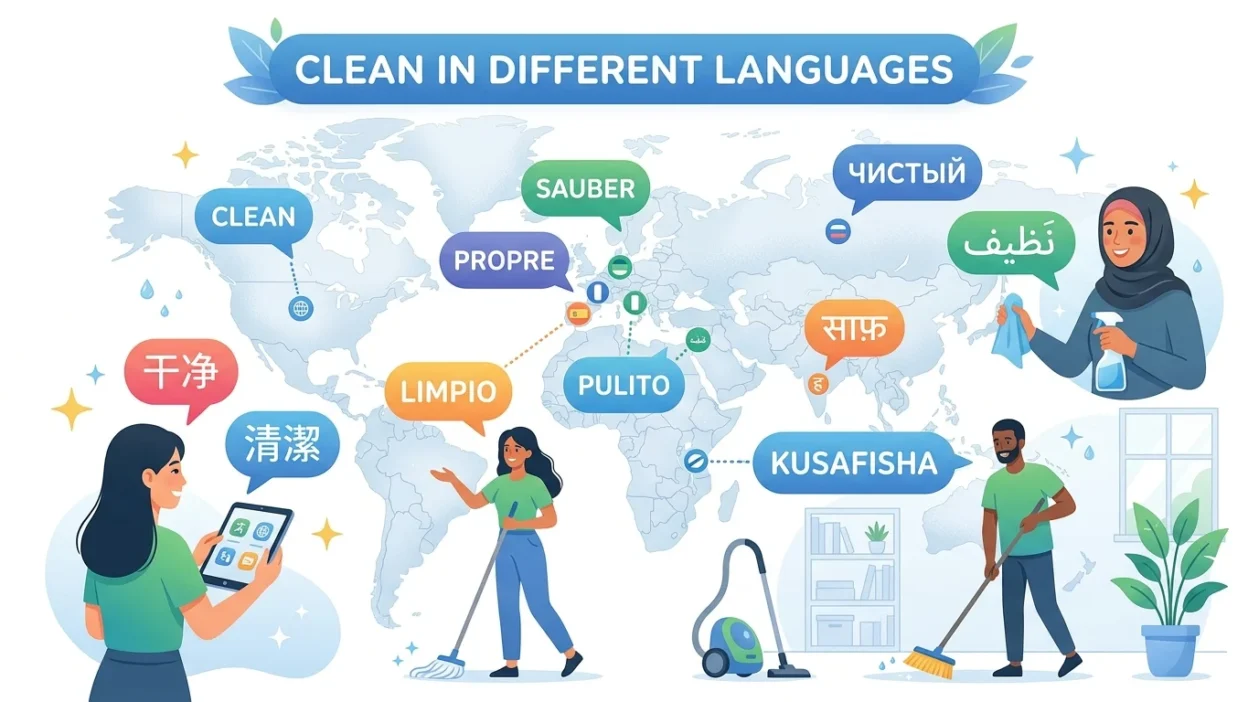
If you want to learn clean in different languages, this page offers a simple way to explore the word across many cultures. It features accurate translation and translations from over 100 other language groups spoken worldwide. Whether you are studying for school, planning travel, or expanding your vocabulary, discovering new ways to say common words helps you communicate with people from different cultures more naturally.
One reason I enjoy using a multilingual resource like this is its audio support. You can listen, pronounce, and read every translation while improving your pronunciation and building confidence. With more than 40 languages included, you can strengthen your speaking skills, improve everyday communication, remember each word more naturally, and understand how the same meaning is expressed around the world.
Clean in Different Languages Table
| Language | Translation | Pronunciation | Example Sentence | English Meaning |
|---|---|---|---|---|
| English | Clean | Kleen | The room is clean. | The room is tidy. |
| Spanish | Limpio | LEEM-pyo | La casa está limpia. | The house is clean. |
| French | Propre | PRO-pruh | La chambre est propre. | The room is clean. |
| German | Sauber | ZOW-ber | Das Auto ist sauber. | The car is clean. |
| Italian | Pulito | Poo-LEE-to | La cucina è pulita. | The kitchen is clean. |
| Portuguese | Limpo | LEEM-po | O quarto está limpo. | The bedroom is clean. |
| Dutch | Schoon | Skhohn | Het huis is schoon. | The house is clean. |
| Swedish | Ren | Ren | Bordet är rent. | The table is clean. |
| Norwegian | Ren | Ren | Rommet er rent. | The room is clean. |
| Danish | Ren | Ren | Køkkenet er rent. | The kitchen is clean. |
| Finnish | Puhdas | POO-das | Huone on puhdas. | The room is clean. |
| Icelandic | Hreinn | HRAYT-n | Húsið er hreint. | The house is clean. |
| Irish | Glan | Glan | Tá an seomra glan. | The room is clean. |
| Welsh | Glân | Glaan | Mae’r tŷ yn lân. | The house is clean. |
| Scottish Gaelic | Glan | Glan | Tha an taigh glan. | The house is clean. |
| Polish | Czysty | CHIS-ti | Pokój jest czysty. | The room is clean. |
| Czech | Čistý | CHIS-tee | Pokoj je čistý. | The room is clean. |
| Slovak | Čistý | CHEES-tee | Dom je čistý. | The house is clean. |
| Slovenian | Čist | Cheest | Soba je čista. | The room is clean. |
| Croatian | Čist | Cheest | Kuća je čista. | The house is clean. |
| Serbian | Чист (Čist) | Cheest | Soba je čista. | The room is clean. |
| Bosnian | Čist | Cheest | Stan je čist. | The apartment is clean. |
| Romanian | Curat | Koo-RAHT | Camera este curată. | The room is clean. |
| Hungarian | Tiszta | TEES-ta | A ház tiszta. | The house is clean. |
| Albanian | I pastër | Ee PAS-ter | Dhoma është e pastër. | The room is clean. |
| Greek | Καθαρός | Ka-tha-ROS | Το σπίτι είναι καθαρό. | The house is clean. |
| Russian | Чистый | CHEES-tee | Комната чистая. | The room is clean. |
| Ukrainian | Чистий | CHIS-tee | Будинок чистий. | The house is clean. |
| Belarusian | Чысты | CHIS-ty | Пакой чысты. | The room is clean. |
| Bulgarian | Чист | Chist | Къщата е чиста. | The house is clean. |
| Macedonian | Чист | Chist | Собата е чиста. | The room is clean. |
| Lithuanian | Švarus | SHVA-rus | Kambarys švarus. | The room is clean. |
| Latvian | Tīrs | Teers | Māja ir tīra. | The house is clean. |
| Estonian | Puhas | POO-has | Tuba on puhas. | The room is clean. |
| Turkish | Temiz | Teh-MEEZ | Oda temiz. | The room is clean. |
| Azerbaijani | Təmiz | Teh-MEEZ | Ev təmizdir. | The house is clean. |
| Kazakh | Таза | Ta-ZA | Бөлме таза. | The room is clean. |
| Uzbek | Toza | To-ZA | Uy toza. | The house is clean. |
| Kyrgyz | Таза | Ta-ZA | Бөлмө таза. | The room is clean. |
| Turkmen | Arassa | A-ra-SA | Jaý arassa. | The house is clean. |
| Arabic | نظيف | Na-ZEEF | الغرفة نظيفة. | The room is clean. |
| Hebrew | נקי | Na-KEE | החדר נקי. | The room is clean. |
| Persian | تمیز | Ta-MEEZ | اتاق تمیز است. | The room is clean. |
| Urdu | صاف | Saaf | کمرہ صاف ہے۔ | The room is clean. |
| Hindi | साफ | Saaf | कमरा साफ है। | The room is clean. |
| Bengali | পরিষ্কার | Po-ri-SHKAR | ঘর পরিষ্কার। | The room is clean. |
| Punjabi | ਸਾਫ਼ | Saaf | ਕਮਰਾ ਸਾਫ਼ ਹੈ। | The room is clean. |
| Gujarati | સ્વચ્છ | Swachh | ઓરડો સ્વચ્છ છે. | The room is clean. |
| Marathi | स्वच्छ | Swachh | खोली स्वच्छ आहे. | The room is clean. |
| Nepali | सफा | Sa-fa | कोठा सफा छ। | The room is clean. |
| Sinhala | පිරිසිදු | Pi-ri-si-du | කාමරය පිරිසිදුයි. | The room is clean. |
| Tamil | சுத்தம் | Sut-tham | அறை சுத்தமாக உள்ளது. | The room is clean. |
| Telugu | శుభ్రం | Shu-bhram | గది శుభ్రంగా ఉంది. | The room is clean. |
| Kannada | ಸ್ವಚ್ಛ | Swa-cha | ಕೊಠಡಿ ಸ್ವಚ್ಛವಾಗಿದೆ. | The room is clean. |
| Malayalam | വൃത്തിയുള്ള | Vrit-thi-yul-la | മുറി വൃത്തിയുള്ളതാണ്. | The room is clean. |
| Thai | สะอาด | Sa-at | ห้องสะอาด | The room is clean. |
| Vietnamese | Sạch | Sak | Phòng sạch. | The room is clean. |
| Indonesian | Bersih | Ber-see | Rumah bersih. | The house is clean. |
| Malay | Bersih | Ber-see | Bilik itu bersih. | The room is clean. |
| Filipino | Malinis | Ma-li-NIS | Malinis ang bahay. | The house is clean. |
| Chinese (Simplified) | 干净 | Gan-jing | 房间很干净。 | The room is clean. |
| Chinese (Traditional) | 乾淨 | Gan-jing | 房間很乾淨。 | The room is clean. |
| Japanese | きれい | Ki-rei | 部屋はきれいです。 | The room is clean. |
| Korean | 깨끗한 | Kkae-kkeut-han | 방이 깨끗합니다. | The room is clean. |
| Mongolian | Цэвэр | Tse-ver | Өрөө цэвэр байна. | The room is clean. |
| Swahili | Safi | SA-fi | Nyumba ni safi. | The house is clean. |
| Zulu | Hlanzekile | Hlan-ze-KEH-le | Igumbi lihlanzekile. | The room is clean. |
| Xhosa | Cocekile | Cho-ce-KEE-le | Indlu icocekile. | The house is clean. |
| Afrikaans | Skoon | Skoon | Die kamer is skoon. | The room is clean. |
| Somali | Nadiif | Na-DEEF | Gurigu waa nadiif. | The house is clean. |
| Amharic | ንጹህ | Nit-sooh | ክፍሉ ንጹህ ነው። | The room is clean. |
| Haitian Creole | Pwòp | Pwop | Kay la pwòp. | The house is clean. |
How to Say Clean in Different Languages
Knowing how to say clean in different languages helps you communicate while traveling, studying abroad, or learning a new language. The word may describe a clean room, clean clothes, clean water, or personal hygiene. Although pronunciation differs from country to country, the idea of cleanliness is universally understood.
Clean Translations Around the World
These clean translations cover languages spoken across Europe, Asia, Africa, and the Americas. Whether you’re expanding your vocabulary or creating multilingual content, learning clean around the world gives you practical expressions that can be used in everyday conversations.
Why Learn the Word “Clean” in Multiple Languages?
Learning common adjectives like “clean” makes daily conversations easier. You can use these translations when checking into hotels, asking about hygiene, describing your surroundings, or practicing new vocabulary. Since cleanliness is a universal concept, this is one of the most practical words to know in many languages.
Tips to Remember Clean in All Languages
- Practice five new translations every day.
- Repeat each pronunciation aloud.
- Use the example sentences in daily conversation.
- Group similar languages together for easier learning.
- Review the list regularly to improve long-term memory.
Conclusion
Learning clean in different languages is a practical way to improve your vocabulary while exploring cultures from around the world. With these 70 translations, pronunciations, and examples, you’ll be able to recognize and use the word confidently in many international situations.
FAQs:
1. How do you say clean in different languages?
The word “clean” has different translations depending on the language, such as limpio in Spanish, propre in French, sauber in German, and 干净 (gānjìng) in Chinese.
2. Why should I learn clean in all languages?
Learning common words like “clean” improves travel communication, language learning, and everyday conversations.
3. Which language uses the word “temiz” for clean?
Turkish and Azerbaijani both commonly use temiz to mean “clean.”
4. Are these clean translations suitable for everyday conversation?
Yes. The translations listed here are commonly used in daily speech and are suitable for describing clean places, objects, and environments.
5. What is the easiest way to memorize clean around the world?
Practice a few languages each day, repeat the pronunciation aloud, and use the example sentences to remember the vocabulary naturally.

Roman Miles is an author at Lingoboxes, a language learning platform. He writes clear and engaging articles that help readers understand different languages, grammar rules, vocabulary, and cultural expressions effectively.